
The digital landscape of 2026 is no longer defined by “going digital”, it is defined by being “AI-native.” For modern enterprises, IT services have shifted from being a back-office support function to the literal engine of business strategy. Whether it’s a mid-sized retailer or a global conglomerate, the integration of high-level tech stacks is the dividing line between market leaders and those left behind.
In this blog, we explore how IT services for business transformation are rewriting the rules of operations, from the way code is deployed to how a customer’s query is resolved.
1. Cloud Computing: From Storage to Strategy
Cloud adoption has moved past the “lift and shift” phase. Today, cloud computing services for business act as the foundational layer for all innovation. In 2026, we see a heavy lean toward “Industry Clouds”, platforms pre-configured with the compliance and regulatory tools specific to sectors like healthcare or finance.
The Benefits of Cloud Migration
Why are companies still migrating? The benefits of cloud migration in the current era go far beyond saving on hardware. They include:
- Elasticity: The ability to scale compute power up or down instantly during peak demand.
- Disaster Resilience: Using automated failovers and air-gapped cloud storage to ensure 24/7 uptime.
- FinOps Integration: Modern cloud services now include “cost intelligence” tools that use AI to predict and optimize monthly spending.
2. AI and Automation: The New Workforce
The most significant shift in recent years is the transition from simple chatbots to AI and automation solutions that act as autonomous agents. We are no longer just “using” AI; we are orchestrating it.
The Role of AI in Business Operations
The role of AI in business operations has matured into what experts call “Agentic AI.” These are systems that don’t just provide data; they take action. For instance:
- In Supply Chains: AI predicts inventory shortages and automatically places orders with vendors.
- In Finance: AI agents handle complex reconciliation and compliance monitoring without human intervention.
- In Customer Service: Hyper-personalized systems analyze a customer’s history in milliseconds to provide tailored solutions before the user even types a full question.
3. Streamlining Workflows with Automation
Efficiency is the currency of 2026. Companies are aggressively adopting business process automation solutions to eliminate the “friction” of manual tasks. This isn’t just about data entry anymore; it’s about “Hyperautomation” – the practice of automating everything that can possibly be automated.
By redesigning workflows rather than just patching them, businesses are seeing operational cost reductions of up to 30%. From automated employee onboarding to AI-driven invoice processing, these solutions allow human talent to focus on high-value creative and strategic work.
4. DevOps: The Speed of Innovation
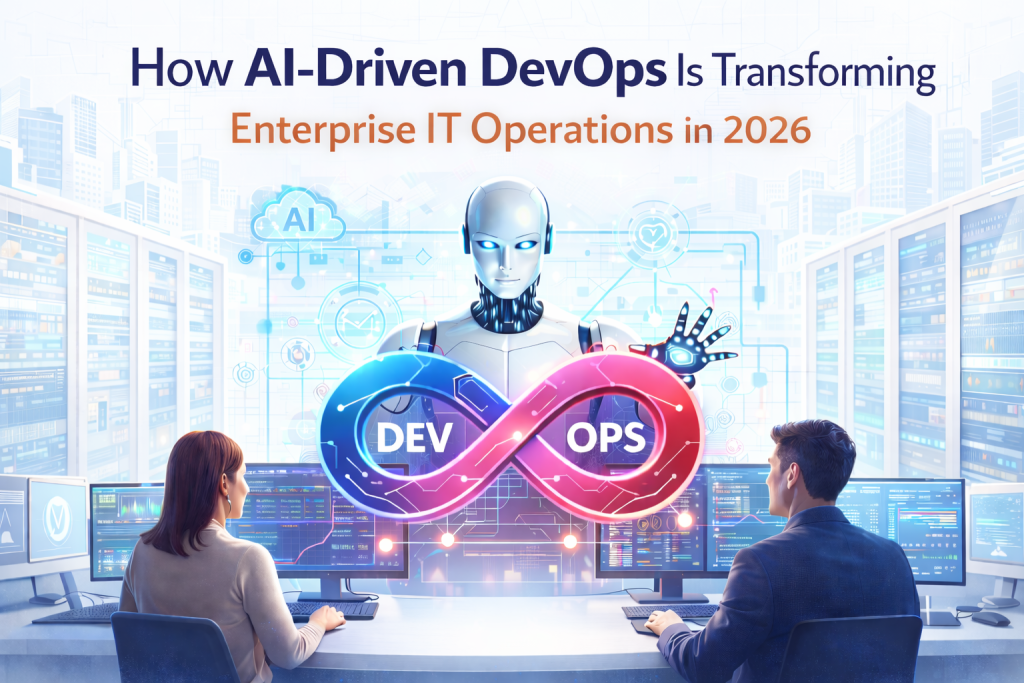
For a business to be agile, its software must be updated constantly. DevOps services for enterprises have evolved into “Platform Engineering.” Instead of developers struggling with infrastructure, they now use “Internal Developer Platforms” (IDPs). These platforms provide a “golden path”—a standardized, secure way to deploy software that ensures every update is compliant with global security standards like GDPR.
By integrating security directly into the pipeline (DevSecOps), companies can release features daily instead of monthly, responding to market trends in real-time.
5. Custom Software vs. Off-the-Shelf
In a world of generic SaaS products, custom software development services provide the “secret sauce” for competitive differentiation. Off-the-shelf software often forces a business to change its processes to fit the tool. Custom software does the opposite: it is built around the unique workflows of the business.
Why Go Custom?
- Ownership of IP: You own the code and the roadmap, meaning you aren’t at the mercy of a vendor’s update schedule.
- Seamless Integration: Custom tools are designed to talk to your existing legacy systems, preventing the dreaded “data silos.”
- AI Readiness: Custom builds allow for deeper integration of proprietary AI models that give you a unique edge over competitors using generic tools.
Summary: The Transformation Roadmap
Modern IT services are no longer a set of disconnected tools; they are an ecosystem. IT services for business transformation succeed when cloud, AI, and DevOps work in harmony. As we move further into 2026, the businesses that thrive will be those that treat their IT infrastructure as a living, breathing part of their value proposition.
FAQs
What are the primary benefits of cloud migration for a small business?
Beyond cost savings, cloud migration offers small businesses enterprise-level security, the ability to work from anywhere, and access to advanced AI tools that were previously only affordable for large corporations.
How does the role of AI in business operations differ from traditional automation?
Traditional automation follows “if-then” rules to handle repetitive tasks. AI, however, can handle unstructured data, learn from patterns, and make decisions in real-time, allowing it to manage much more complex workflows.
Are business process automation solutions expensive to implement?
While there is an upfront cost, most businesses see a return on investment (ROI) within 12 to 18 months through reduced labor costs, fewer errors, and increased throughput.
Why should an enterprise invest in DevOps services?
DevOps services allow for faster software delivery and higher quality. It breaks down the walls between development and operations teams, leading to more stable systems and a quicker response to customer needs.
When should a company choose custom software development over a standard SaaS product?
You should choose custom software when your business process is a “competitive advantage.” If a standard tool requires you to compromise your unique way of doing business, or if you need to integrate complex, proprietary data, custom is the way to go.