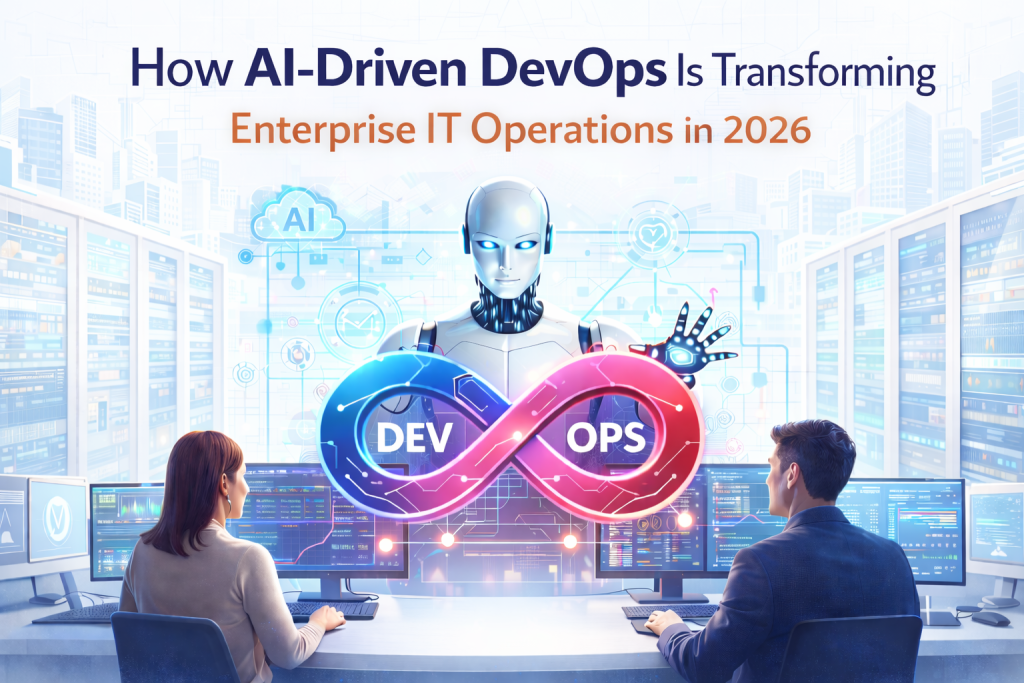

Imagine an IT department that never sleeps, never gets overwhelmed by ticket spikes, and fixes your laptop’s crashing software before you even realise there’s a glitch. This isn’t a scene from a sci-fi novel; it is the reality of 2026. As global AI spending surges toward $2.52 trillion this year, the backbone of corporate stability – IT Service Management (ITSM) is undergoing a radical metamorphosis.
The traditional “break-fix” model is dead. In its place, AI-driven ITSM has emerged as a powerhouse of efficiency, shifting the focus from reactive firefighting to proactive, autonomous service delivery. If you are still managing IT through manual triage and siloed spreadsheets, you aren’t just behind—you are invisible to the speed of modern business.
The Dawn of the Intelligent Service Desk
For decades, the IT service desk was a bottleneck. Users waited
hours for password resets, and Level 1 agents spent their days performing soul-crushing, repetitive tasks. The intelligent service desk has shattered this paradigm by embedding Natural Language Processing (NLP) and Machine Learning (ML) into the very fabric of user interaction.
Beyond the Basic Chatbot
In 2026, we have moved past the “clunky” chatbots of the early 2020s. Today’s intelligent service desk utilises Agentic AI – autonomous systems that don’t just talk but act. These agents can:
- Authenticate tervention.users via biometric signals.
- Execute complex workflows like software provisioning.
- Navigate cross-departmental permissions without human in
According to Gartner, organisations implementing these advanced tools have seen a 30% reduction in operational costs at the contact centre level alone.
Revolutionising Workflow with AI Automation in IT Operations
Efficiency is the new currency of IT. AI automation in IT operations (AIOps) is the engine driving this change. By analysing massive volumes of logs, metrics, and events in real-time, AI identifies meaningful insights that a human eye would miss among thousands of alerts.
Eliminating “Alert Fatigue”
One of the greatest challenges in legacy systems was “noise.” IT teams were often buried under a mountain of false positives. AI automation in IT operations solves this by:
- Event Correlation: Grouping related alerts into a single “incident” to prevent duplicate work.
- Anomaly Detection: Establishing a “normal” baseline for system performance and flagging only genuine deviations.
- Self-Healing Infrastructure: Automatically restarting services or scaling cloud resources when a threshold is met.
Studies show that high-performing IT teams now save 12-16% of their total time simply by automating ticket categorisation and routing.
Predictive Incident Management: The End of Downtime
The most significant shift in ITSM transformation is the move toward “Zero Downtime.” This is made possible through predictive incident management.
Instead of waiting for a server to crash, ML models analyse historical data and live telemetry to forecast potential failures. For example, if a specific database cluster shows a pattern of increasing latency that previously led to a crash, the AI triggers a preventive maintenance ticket.
Quantifiable Impact
The data supporting this shift is staggering:
- Reduction in Recurring Incidents: AI-driven pattern detection reduces repeat issues by 30-35%.
- Faster Detection: Predictive models improve Mean Time to Detect (MTTD) by 15-20%.
- SLA Compliance: Organizations using AI-driven monitoring consistently report 30% better SLA performance.
By preventing the fire rather than just putting it out, IT departments are evolving from cost centres into strategic value drivers.
Reshaping the Digital Employee Experience (DEX)
ITSM is no longer just about fixing machines; it is about empowering people. In a hybrid world, the digital employee experience is the cornerstone of retention and productivity. AI-driven ITSM provides a personalised, “frictionless” environment for the modern workforce.
- Proactive Remediation: If an employee’s device is running low on disk space, the AI can trigger a cleanup script or suggest a cloud migration before the user’s performance is throttled.
- Human-AI Teaming: AI handles the “busy work,” allowing human agents to focus on complex, high-empathy issues that require creative problem-solving.
- Knowledge Management: AI-powered systems can scan thousands of internal documents to provide agents with “Next-Best Action” suggestions, improving user experience metrics by up to 45%.
Challenges and Governance in 2026
While the benefits are clear, the ITSM transformation is not without its hurdles. With great automation comes the need for great oversight.
- AI Trust: Approximately 55% of IT professionals still believe human oversight is essential for AI-driven decisions.
- Skill Gaps: As routine roles vanish, there is an urgent demand for “AI Orchestrators” – IT pros who can manage and refine these autonomous systems.
- Ethics and Compliance: With the European AI Act in full effect, IT leaders must ensure their automation scripts are transparent, unbiased, and secure.
The Path Forward: Implementing AI in Your ITSM Strategy
To stay competitive, your organisation must move beyond “pilot purgatory” and into full integration.
| Strategy Phase | Action Item | Expected Outcome |
|---|---|---|
| Phase 1: Foundation |
Consolidate data silos and clean historical logs. | Better ML model accuracy. |
| Phase 2: Automation |
Deploy AI for password resets and ticket routing. | 20% immediate reduction in L1 workload. |
| Phase 3: Prediction |
Implement AIOps for infrastructure monitoring. | Reduction in critical outages. |
| Phase 4: Autonomy |
Transition to Agentic AI for end-to-end resolution. | Maximum scalability and 24/7 support. |
Conclusion
The ITSM transformation driven by artificial intelligence is no longer a luxury – it is a survival mechanism. By embracing AI-driven ITSM, AI automation in IT operations, and predictive incident management, businesses can finally break the cycle of reactive support.
The goal of the intelligent service desk isn’t to replace the human element; it’s to liberate it. When the machines handle the mundane, your IT team is free to innovate, strategise, and build the future.
Are you ready to stop fighting fires and start predicting them? Contact our experts today for a personalised AI-ITSM readiness assessment.
FAQs
1. What is the difference between traditional ITSM and AI-driven ITSM?
Traditional ITSM relies on manual inputs and reactive workflows (a user reports a problem, and an agent fixes it). AI-driven ITSM uses machine learning and automation to identify, categorise, and often resolve issues before a user even notices them.
2. How does predictive incident management actually work?
It uses “multivariate forecasting.” This means the AI looks at hundreds of data points – like CPU usage, login patterns, and temperature to find subtle correlations that precede a system failure, allowing IT to intervene early.
3. Will AI-driven automation replace IT support jobs?
While it automates routine tasks, it creates a higher demand for specialised roles. The focus shifts from “fixing the laptop” to “optimising the AI models” that keep the entire organisation running smoothly.
4. What are the first steps to adopting AI automation in IT operations?
The first step is data hygiene. AI is only as good as the data it learns from. Start by centralising your logs and ensuring your current ITSM platform supports API-based integrations for AI tools.
5. Can a small business benefit from an intelligent service desk?
Absolutely. Many modern ITSM vendors now offer “AI-as-a-Service,” allowing smaller companies to use advanced automation without needing a massive in-house data science team.